Monday, July 13, 2009

You will be hearing from us shortly

Because of a Lindamood-Bell scheduling fluke, I have tomorrow (Tuesday) off. And because Lindamood-Bell is a seasonal job, I am spending tonight and tomorrow applying for more permanent jobs. So is my roommate. It makes us punchy.

I have applied to charter schools and coffee shops, children's museums and publishing houses, over 55 in all since I started sending out my resume in March. Dr. Gauthier said at church yesterday that searching for a job causes the same amount of stress in your body as the death of a family member. I am starting to believe him.

---

You feel adequate to the demands of this position?
What qualities to you feel you
Personally have to offer?

Ah

Let us consider your application form.
Your qualifications, though impressive, are
Not, we must admit, precisely what
We had in mind. Would you care
To defend your relevance?

Indeed

Now your age. Perhaps you feel able
To make your own comment about that,
Too? We are conscious ourselves
Of the need for a candidate with precisely
The right degree of immaturity.

So glad we agree

And now a delicate matter: your looks.
You do appreciate this work involves
Contact with the actual public? Might they,
Perhaps, find your appearance
Disturbing?

Quite so

And your accent. That is the way
You have always spoken, is it? What
Of your education? Were
You educated? We mean, of course,
Where were you educated?
And how
Much of a handicap is that to you,
Would you say?
Married, children,
We see. The usual dubious
Desire to perpetuate what had better
Not have happened at all. We do not
Ask what domestic disasters shimmer
Behind that vaguely unsuitable address.

And where you born -- ?

Yes. Pity.

So glad we agree.

- U. A. Fanthorpe

Saturday, July 4, 2009

We create the magic of learning.

These are magic stones. They are plastic and shiny and cheap, and kids covet them. We use them at work to buy students' cooperation.

I'm working for the summer at a tutoring center. I work with eight students a day for one hour each. My youngest kid has been 8; my oldest thus far has been 17.

Most of the students are used to failure and have self-esteem problems. Part of my job is to keep that frustration away by using "positive error handling technique," which is a cross between improv's "Yes, And" principle and the Socratic method. Basically, when a kid gives a wrong answer, I'm supposed to affirm something about her response. Then, instead of telling her the answer, I'm supposed to help her figure it out for herself, then shower her with praise (in the form of stones) when she gets the answer right.

That works 80%, and it keeps morale up. But a few times a day, this error handling technique leads to one of the following sorts of conversations.


"George" is 14 years old. He has Autism, which means that he can read and remember words but can't necessarily picture what they mean.

Me: "The girl ran through the tall grass." What do those words make you picture?

George: The girl ran through the tall grass.

Me: Great! Those were the words. Now tell me what that made you picture in your head.

George: The girl ran through the tall grass.

Me: Yes, she did. What do you picture for the girl?

George: Ran through the tall grass.

Me: Yes, that's what she's doing. What does she look like?

George: The girl ran through the tall grass.

Me: Is the girl tall or short?

George: Tall grass.

Me: The grass is tall. You're right. What about the girl?

George: The girl ran through the tall grass.

More often, though, George just doesn't answer me, and I find myself wondering if I've turned mute or invisible, or maybe have just asked such an idiotic question that I'm not worth answering. After all, I'm repeating myself over and over, too, and we could be stuck in this perfect echolalial circle forever.


"John" is 12, athletic, and goofy. He spent pre-school through first grade in and out of the hospital for multiple heart surgeries, so he never caught on to phonics, much less reading.

<
I hold up an "oi" flashcard.>

Me: What do these letters say?

John: "Aw."

Me: Oh, good, I did see vowels. When you say "aw," what's the first letter you picture?

John: W.

Me: Great! I did see a W in "aw." Did you see anything before the W?

John: O.

Me: You're right that there was another vowel before the W. What would O-W say?

John: "oi."

Me: Yeah, I definitely pictured an O in "oi." What's the second letter you picture in "oi"?

John: H.

Me: H is a letter, you're right. Let's look at the card again.

John: Ee.

Me: I would hear a little "ee" sound in there at the end. How would you say the whole thing?

John: I!

Me: Oh! I did see an I in there. Did you see it coming first or last?

John: In the middle.

Me: Um, ok. This actually says oi.

John: That's what I said!

Me: You did say parts of it, you're right. Touch the card and say it again.

John: Oi.

Me: GREAT! Give me a high five! You got it! Let's see how fast we can do the next ones, ok?

<I hold up F, Qu, Ee, Ll, and Oi, to see if he can remember Oi when he's not thinking so hard.>

John: Fff! Qua! Ee! Lll! Ooo!

Me: You got those first several perfectly! Let's look at this last one. What's that second letter?

John: I.

Me: Awesome! So what do O and I say when they're together?

John: Aw.

He is so insistent that I wonder if I need my glasses prescription updated, or if I actually remember what O and I say together. That particular curriculum is called Seeing Stars, which is what I do after an hour of desperately blurting out anything positive I can say.

Those are my two most severe kids so far. The others correct themselves pretty easily, they respond to questions, they read Frog and Toad Are Friends with me, and, best of all, they are easily bribed with magic stones. As a temporary job, it definitely beats data entry. At the end of the summer, though, the kids will head back to regular school, and I could be unemployed again.

I may attach baggies of magic stones to my application cover letters from now on.

Saturday, May 16, 2009

Well, in this economy ...

I have followed Career Service's advice this semester and applied for jobs. Lots of jobs. Over 50 at this point, everything Monster, CareerBuilder and Craigslist could give me for the Chicago Area. I've sent my resume everywhere from the American Girl Place to the American Nuclear Society.

Last week, I got an email asking for a phone interview about a comedy writing position. I'll call the interviewer "Gary." I was slightly suspicious to begin with, since Googling the nonsense words in Gary's email signature pulled up an inordinant number of furry event calendars. I didn't want to jump to conclusions, but I did spend most of the following conversation trying hard to avoid imagining Gary in a fox costume.


Me: What kind of comedy writers are you looking for?

Gary:
Funny ones.

Me:
Right. What kind, though? Stage? Screen? Sketch?

Gary:
Screen. We're working on a sitcom.

Me:
What's the premise?

Gary:
I can't tell you a lot, since it hasn't come out yet, and there are intellectual property laws. I can tell you it's about an oddly matched set of roommates.

My head:
Like Friends or Gilligan's Island or Laverne and Shirley or the Odd Couple or Three's Company or Will and Grace or ... or ... or ...


Me:
What level of content are you looking for?

Gary:
Dense. Juicy. More Simpsons than Family Guy.

Me:
How will it be rated?

Gary:
Highly, I hope. We're shooting for a big audience.

Me:
I guess I'm trying to find out what your target audience is. What kind of comedy is this?

Gary:
Why do you care? Is there any kind of comedy you won't write?

Me:
Well, I'm a Christian, so there are some boundaries I'll want to respect.

Gary:
We are into pushing boundaries here. Why don't you come by the office, and we'll see if you're a good match for our team. Is this weekend good?

Me:
Would next week work? I'm graduating from college this weekend.

Gary:
Congratulations! What college?

Me:
Wheaton College.

Gary:
Oh. So the Christian thing ... that wasn't a joke?

Me:
No.

Gary:
You're serious?

Me:
Yes.

Gary:
Christians make me want to gouge out my own eyes.

Me:
Ok.

Gary:
Also, you might as well know, this sitcom is going to be mostly NC17/X. A Wheaton graduate wouldn't be a good fit for us.

Me: Probably not. Thanks for your time.


That is one for the Career Services webpage.

I'm glad he told me he was looking for comedic porn (pornographic comedy?) writers before I took a trip into the city to interview in person.

And so job search continues.

Friday, May 1, 2009

And I didn't know this, either.

I submitted a collage to Kodon to see what an art rejection letter looked like.

I didn't find out. Instead, I got published.* It has been four years now, and I do not suppose I will ever understand Wheaton College.


Title: Bird watching
Medium: Christianity Today, Vogue, packing tape


*My writing, on the other hand, was rejected entirely, including the poem from the previous post.

Tuesday, April 28, 2009

And I didn't know it.

As is customary for a self-respecting writing major, I entered Wheaton's Lowell-Grabel creative writing contest. This year's judge was Wheaton alumna and religion journalist Cathleen Falsani, whose book Sin Boldly I read recently and whose blog I have found well worth stalking. She was beyond encouraging at the awards ceremony.

Duke was awarded first place in creative nonfiction and third place in fiction. I was awarded second place in creative nonfiction and -- get this -- first place in poetry.

Yeah. Poetry. I know.

The poem is about when my family joined Highland Terrace when I was 14 and sulky.

---

One Baptism: A Sestina

I was baptized in the name
of the Father, Son and Holy Spirit
with my father, mother and brother
by a preacher dressed like a fisherman
to keep himself from getting wet.
I was dunked into the heated baptistery

lit by a stained glass dove glowing neon above the baptistery.
The preacher, the Brother, often forgot my name
and, whether because we were related by Spirit
or just out of habit, called me Brother,
forgetting not every Baptist is a man.
He himself refused to get wet,

guarded against getting wet
by wearing rubber pants in the baptistery
under the neon stained glass dove named
(or just symbolic of) the Holy Spirit.
I do not remember how my brother
felt about this preacher, this man

who wanted my dad baptized as a man
because getting his baby head sprinkled wet
by Methodists didn’t count. The chlorinated baptistery,
heated from below and lit from above, named
us as church-members. The spirit
of the thing was lost on my soggy little brother

and my skeptical self. I acknowledge one brother
(who now is grown, practically a man)
as mine, not this preacher, wet
with sweat and sermon spit -- not baptistery
water -- from getting carried away in the Lord’s name,
and I am certainly not his brother, even in spirit.

Was it the same neon stained dove Spirit
shining over my parents and brother
and me who hovered over God-made-Man,
the Man who volunteered to get wet
in his cousin’s muddy makeshift baptistery,
cold with slime and fish, and heard his name?

This brother-man in the baptistery would not get wet, even in the name of the spirit.


*Blade and Steve should be given some of this credit, since they have endured more than their share of Duke's and my rough drafts.

Wednesday, April 22, 2009

Healing

An excerpt from an essay I'm working on concerning the seven sacraments.

-------

Your new dentist asked you how long your mouth had been full of ulcers.

Oh, always.

She diagnosed you with an allergy to a chemical found in most regular and whitening toothpastes. She did not need to write a prescription, but she did recommend that you switch to toothpaste for sensitive teeth.

That’s all?

That’s all.

After a few days, it no longer hurt to eat. Within a week, you were able to drink orange juice or salt your eggs without so much as a wince.

Your new dentist warned you never to use the old toothpaste again, not even a little, not even if it’s the only convenient toothpaste around. That would be like touching only a little poison ivy.

You didn’t need to be told twice.

You couldn’t believe you’d never thought to ask your old dentist why your mouth hurt all the time. You assumed it was supposed to hurt. Was all healing that simple? Were you really not supposed to hurt all the time? Was asking all it took?

Monday, March 2, 2009

"Who do you say that I am?"

Jim Young, the founder of Wheaton's Arena Theater, used to say, "I keep finding Jesus in places I thought he had no business being." Arena continues the tradition of looking for God in unlikely places in a class called Church and Theater.

The thesis: Theater asks questions, and the church provides a safe, nurturing context in which to wrestle with those questions. So how do we go about asking those questions in artistic ways that point people toward God?

Christians, especially Christians in the arts, cannot ignore the media's portrayal of Jesus. We have to trust that our faith is solid enough to stand being rattled around some. The first half of the semester, then, is about who our culture says Jesus is. This translates into our watching a lot of heretical movies.

---

Yiimimangaliso: The Mysteries
In the tradition of medieval mystery plays, Yiimimangaliso hits the high points of the redemption story from creation to Pentacost. The company is from South African.

The story of God's relationship with humanity is told mostly through percussion and dance, with smatterings of English, Afrikaans, Zulu and Xhosa. Angels wear chicken feathers. Adam and Eve are completely nude. Lucifer wears red pleather. Noah's flood mostly uses a watering can, and Jesus' entire childhood is depicted in a short, rhythmic game.

The only thing I can picture being offensive (unless you find dance in church offensive) is the occasional resemblance to minstrel shows. The company, though, is South African, not African American, so I don't know their familiarity with minstrelsy.

---

Leonard Bernstein's Mass
Unlike the other pieces we've talked about together, Bernstein's not-exactly-a-musical-and-not-quite-an-opera-and-certainly-not-a-straight-Mass is the only one that does not portray Jesus explicitly. The Celebrant and choir sing the traditional Latin text for the Mass, and they are interrupted periodically by parishioners voicing their doubts and demands. The chaos eventually takes its toll on the Celebrant (pastor). The congregation turns on him and demands he fix their lives. He eventually burns out, drops the chalice, and notices for the first time that red wine isn't red at all, but sort of brown and blue. He also rhymes "Adonai" with "I don't know," which gets him major points in my nerdy writing major book.

Some Wheaton friends accuse me of cynicism about the church, but I grew up in Greenville, Texas. Specifically, I grew up in Aldersgate (nondenominational) and then Highland Terrace (Southern Baptist), which gives me a juicy background of having some pastors being run off and other pastors running off on their own, all while their congregations squabble over nothing in particular. Bernstein's Mass portrays the church not as it should be but as it often is -- rich in history and truth but filled with people who are sometimes actively destructive, sometimes hypocritical, sometimes quietly struggling, and pastors aren't immune.

I have listened to the soundtrack on my own at least five times since we heard it in class.

---

Chocolate Jesus
Cosimo Cavallaro exhibited his anatomically correct sculpture of Jesus during Holy Week 2007. It is entirely chocolate. We could neither confirm nor deny Cavallaro's interest in Tom Waits' Mule Variations.

I am less offended by this now that Walgreens has their Easter candy out. There are chocolate crosses right there next to the bunnies and eggs. They are four dollars. I am much more offended by those than by the Cavallaro sculpture. We are supposed to eat the body of Christ, though it is usually somewhat healthier -- a torn piece of bread or an oyster cracker.

There is nothing cute about this Cavallaro's Jesus. He is naked and in pain. The crosses at Walgreens were adorable enough to make you forget they were instruments of torture. Nobody eats chocolate electric chairs or even chocolate guns.

---

Jesus of Montreal
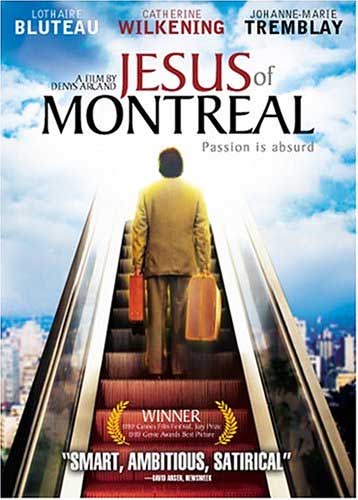
It's 1988, and a Canadian bishop asks a young director to revamp the parish's decades-old passion play. The director gathers actors -- some with more experience in beer commercials than any other venue -- and revamps not only the presentation of the Passion story but also the entire script, incorporating recent archeological digs in the Palestine and soliloquys from Hamlet. The Catholic church is not pleased.

As the film goes on, the actors get their own identities entangled with their characters, and the movie becomes allegorical. The actors are disciples. The director is Jesus. A slick lawyer is Satan. A film studio is the temple. Art is religion.

That last bit is where I have the hiccough: It seems like art turns into a replacement religion somewhere along the way. That, as well as a few stray comments about everyone finding their own seperate paths to salvation, is probably why the movie was considered so offensive. Unless I missed something, which is possible, since the movie was in French and subtitles don't always cut it.

Oh, and crucifixion is crucifixion, and ____ ______ is resurrection. I won't ruin it for you; see the movie.

---

But I am about to ruin another movie, because neither its craft nor its theology earn it a recommendation.

The Last Temptation of Christ
I once heard a speaker at a youth camp say that, ever since this movie came out, he's boycotted everything by anyone involved in the abomination, and he encouraged us to do the same. (I know David Bowie's pocketbook is seriously hurting from losing his teenage Southern Baptist demographic after his role as Pontius Pilate.)

Willem Dafoe is a kind of anti-Christ, not in a Tim LaHaye/Jerry B. Jenkins sense, but in that his attitude is opposite of Christ's in almost every scene. Scorsese's Christ is not sinless, he's just too cowardly to commit any particularly noteworthy sins. He wants to be a regular guy, but God won't leave him alone. Neither will Satan, for that matter. As a result, he comes down off the cross, gets married a few times, has kids, chews out Paul for misrepresenting him. Judas acts like the only one with much sense at all; despite Judas' best efforts, Jesus has ruined humanity's chance at salvation. Maybe there are other interpretations, but that's what came across after one (admittedly sleepy) viewing.

Any Christians left in the theater probably walked out by the Jesus/Mary Magdelene sex scene (which our professor graciously censored), but they missed the big surprise twist at the end of the movie:

It was a dream. The whole time. Like Dorothy and Donnie, Jesus has a vision of an outrageous scenario in which he escapes the regular world and has a chance to do what he's always wanted to do. Then he wakes up, back on the cross, and the credits roll in all their 80's majesty. Peter Gabriel sings.

It's like bad Bible fanfiction. As far as craft goes, Last Temptation is to film as Left Behind is to literature. It just happens to swing crazy-liberal instead of crazy-conservative. I don't know which one is more upsetting. Last Temptation is more blasphemous, but Left Behind is more misleading. At least Scorsese disclaimed at the beginning that his film is not based at all on the Gospels, while LaHaye and Jenkins are marketed like their novels are realistic portrayals of Revelation.

---

The media saturates us with its own images of Jesus and the church. They are loudest when they use a microphone and megaphone at the same time. What are they finding out about him when they come to church?


Ain't it crazy
What's revealed when you're not looking all that close
Ain't it crazy
How we put to death the ones we need the most?